7th of September, 2025
From the first murderer to the betrayer of the Son of Man, these spirits underlie the forces of perdition that have haunted humanity from the beginning.
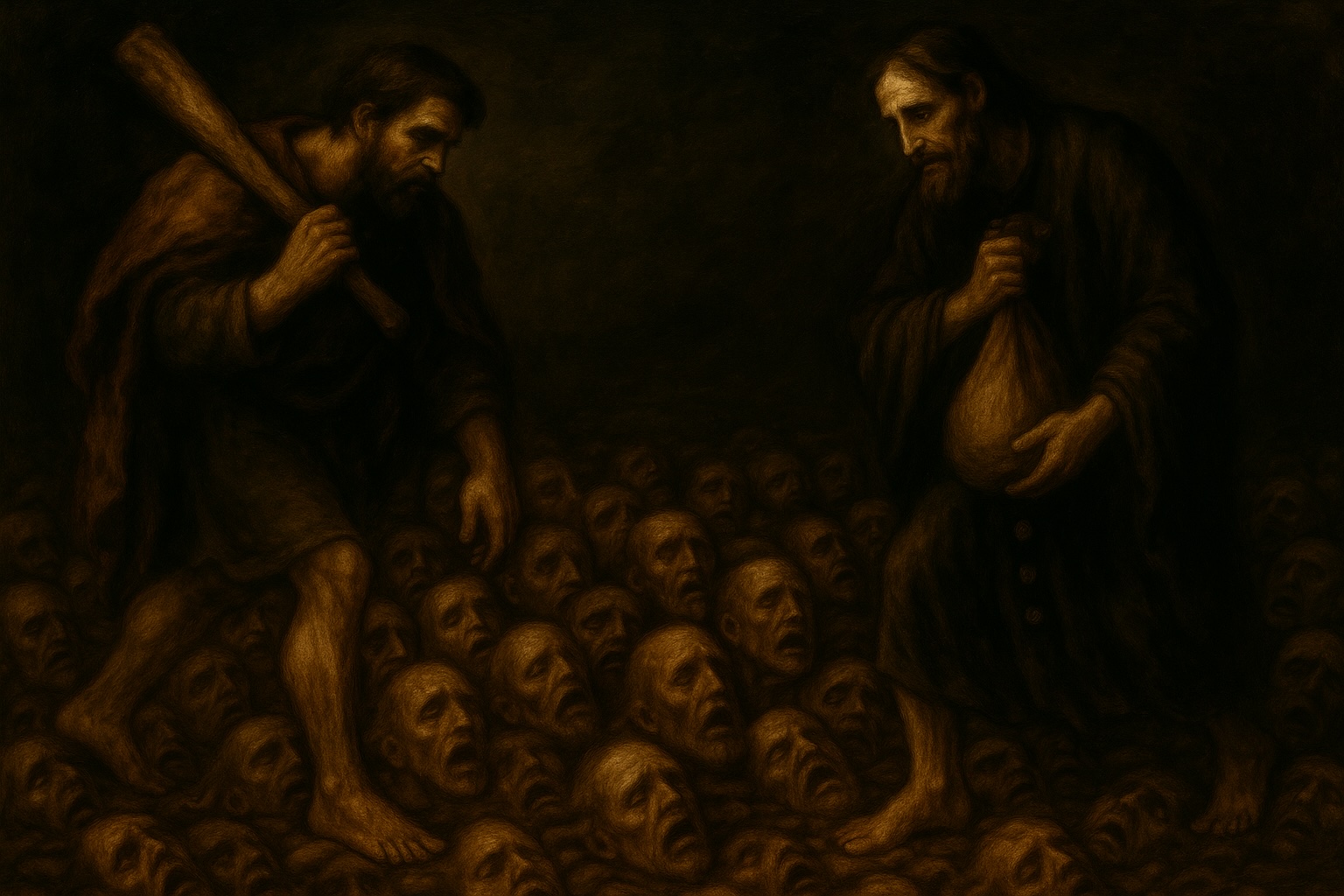
Warning: This article contains vivid descriptions of spiritual corruption and eternal torment. The content is intense at times and may be disturbing to sensitive readers. Reader discretion is advised.
Motivation
Before we confront the subject of the identity of the Antichrist, we must step back and see the bigger picture.
An actor may recite lines, but until they understand the character — who they are, what drives them — the performance is hollow.
The same is true here. Without understanding the deeper principles, our ideas are only empty conjecture.
Our task is not to guess. It is to understand. To see the antichrist spirit as it is, to perceive the balance between Christ and antichrist, and to know them at their root — before we attempt to name them in our own time.
Two “Antichrists”
There are two antichrist types in Scripture.
The first is Cain. He was the first murderer, and then the first to cover it with a lie: “I do not know. Am I my brother’s keeper?” (Genesis 4:8–9).
Jesus later names this spirit: “The devil was a murderer from the beginning… he is a liar and the father of it” (John 8:44).
Cain also became the first man to bear a mark — the first mark of the beast.
But before him, the same spirit was already at work in the Garden. The serpent twisted God’s word with a lie: “You will not surely die” (Genesis 3:4). That lie led directly to death. Murder was its intent.
So the first antichrist spirit is not merely human. It is older than Cain. Older than Adam. It is Satan — the devil himself.
The second antichrist type was Judas: the thief (John 12:6) and betrayer (Luke 22:48). Jesus calls him the “son of perdition” (John 17:12), and Paul links him to the “man of sin” who would be revealed prior to Christ’s return (2 Thessalonians 2:3).
If the first antichrist spirit is the dragon, the second antichrist spirit is the dragon’s tail (Revelation 12:3-4). Together, Cain and Judas embody these two facets of the antichrist spirit — its beginning, and its end.
They line up with Jesus’ words in John 10:10 about the thief who comes to “steal, and to kill, and to destroy,” uniting Judas (steal/betray), Cain (kill), and the final man of sin — the son of perdition (destruction).
The counterpart to both these antichrist types is Christ Himself, who also likened himself to a thief (Matthew 24:43).
He was firstly the “Lamb slain from the foundation of the world” (Revelation 13:8), bringing to mind the gentle and obedient Abel who was indeed slain at the foundation of the world.
But He also came as the Christ — the Son of Man — in stark relief to the other antichrist type — the son of perdition.
The Curse of Cain
Cain, the first murderer and first bearer of the antichrist spirit, now bears a curse that reflects his nature.
Genesis 4:11-12So now you are cursed from the earth, which has opened its mouth to receive your brother’s blood from your hand. When you till the ground, it shall no longer yield its strength to you. A fugitive and a vagabond you shall be on the earth.
This was no ordinary curse about farming. The ground that received Abel’s blood points to something far deeper: the inability to rest in death. Cain’s spirit would wander the earth, cursed from rest, the first evil spirit to walk the world.
1 Peter 5:8 echoes this: “Be sober-minded; be watchful. Your adversary the devil prowls around like a roaring lion, seeking someone to devour.”
Job 1:7 shows the same principle: “From where do you come?” Satan answered, “From going to and fro on the earth, and from walking back and forth on it.”
Luke 11:24-26When an unclean spirit goes out of a person, it passes through waterless places seeking rest, and finding none, it says, ‘I will return to my house from which I came.’ And when it comes, it finds it swept and put in order. Then it goes and brings seven other spirits more evil than itself, and they enter and dwell there, and the last state of that person is worse than the first.
The “seven other spirits” echo the vengeance promised in Genesis 4:15 — “vengeance shall be taken on him sevenfold” — for anyone who kills Cain.
The “waterless places” are illustrated in the parable of the rich man and Lazarus. Lazarus rested in peace; the sinner found none: “Send Lazarus that he may dip the tip of his finger in water and cool my tongue” (Luke 16:24).
Cain committed a sin worthy of death, and all who follow his path are consigned to the same fate: endless wandering, finding no rest, until the time of the end.
Genesis 4:23–24 recounts another murderer, Lamech, lamenting to his wives: “If Cain shall be avenged sevenfold, Then Lamech seventy-sevenfold.” The spirit of Cain was spreading.
By the time of the flood, it had infected nearly all of humanity, except Noah and his family (Genesis 6:5, 8).
Non-canonical texts such as 1 Enoch and Jubilees reinforce this concept: when the Nephilim were slain in the flood, their spirits also remained on the earth, wandering as tormenting spirits among humans. They too were punished with Cain’s curse.
The spirit of Cain is the first antichrist spirit. It is the spirit of those who commit sins worthy of death. They become evil spirits, cursed to wander the earth endlessly. This is the same spirit Jesus identified as Satan and the devil — ever roaming, seeking to devour, refused rest, and spreading death and destruction wherever it goes.
The Curse of Judas
If the first antichrist spirit is the devil himself, the second is his son — the man of sin, the son of perdition.
John told us in the first century that this spirit was already present and manifesting.
1 John 2:18, 22Little children, it is the last hour; and as you have heard that the Antichrist is coming, even now many antichrists have come… Who is a liar but he who denies that Jesus is the Christ? He is antichrist who denies the Father and the Son.
The antichrists John mentioned started with them, but left. Judas is the first, but there were others — such as gnostics, like the author of the Gospel of Phillip or the Gospel of Judas — who deny the Father and the Son.
Even in those early days, this second antichrist spirit was spreading. Instead of violence, it embodied theft and betrayal. And in God’s eyes, these are graver sins.
Zechariah 5:3This is the curse that goes out over the face of the whole earth: ‘Every thief shall be expelled,’ according to this side of the scroll; and, ‘Every perjurer shall be expelled,’ according to that side of it.
Judas’ behaviour perfectly illustrates these two curses. He was a thief, taking what was entrusted to him — the money bag, the disciples’ resources. He was also a betrayer, an oath-breaker, turning loyalty and trust into instruments of treachery. The curse targets perjurers (shaba in Hebrew) which refers to swearing falsely or breaking an oath, and is more than simply a lie (sheqer in Hebrew).
Cain’s curse was to wander, never resting. Judas bore a curse far heavier. The scroll declared his house would be consumed, the timber and stone destroyed (Zechariah 5:4) — and that house is the tent of the body, the habitation of the soul. Paul warns:
1 Corinthians 3:17If anyone defiles the temple of God, God will destroy him. For the temple of God is holy, which temple you are.
When the house is gone and the soul not set free, what remains is desolation. Peter speaks of such as being “reserved for the blackness of darkness forever,” (2 Peter 2:17) and Jude calls them “wandering stars” (Jude 1:13), not roaming the earth as spirits like Cain, but bodily, destined to be cast adrift in a void with no light, no sound, no company — the soul trapped in isolation, suspended in an eternal nightmare with no waking and no end. This is perdition. This is outer darkness.
In Christ we see the opposite. Where Judas’ house was consumed, Christ’s was raised. Where the scroll devoured Judas’ temple, Christ declared, “Destroy this temple, and in three days I will raise it up” (John 2:19). Where the soul in darkness is locked in a nightmare, the soul in Christ is released into unending light, clothed in a “house not made with hands, eternal in the heavens” (2 Corinthians 5:1). As Judas became the son of perdition, so Christ stands as the Son of Man, and every soul who trusts in Him finds rest.
And in this is the horrifying reality. For balance to exist — for one company to inherit eternal joy — another must endure eternal ruin. The bliss of the redeemed is held in place by the torment of the lost. If their torment were to cease, the balance would break, and paradise would be lost. The “smoke of their torment ascends forever and ever” (Revelation 14:11), not as a spectacle, but as the counterweight that upholds eternity.
Until the time of the end, with the soul unable to depart, when the body would naturally die, life lingers. They are literally the walking dead. Not zombies, not vampires — yet in essence, they are. Their bodies decay, souls trapped, forced to feed upon the life force of the living to stave off the inevitable darkness. Every breath, every heartbeat, a feeble rebellion against the final consummation of their ruin.
This is why Jesus said, “woe to that man by whom the Son of Man is betrayed! It would have been good for that man if he had not been born” (Matthew 26:24). In betraying Him, Judas unlocked the curse of Zechariah 5. This is the true mark of the beast — not a brand or token, but a fate from which there is no escape. Men will seek death, yet death will flee (Revelation 9:6); even if the body fails, the soul cannot, and the darkness waits, patient and unrelenting.
It’s how Judas died twice. Matthew says he hanged himself (Matthew 27:5), while Acts says he fell and burst open (Acts 1:18). Not a mistake, but a clue as to the horror of what he had become.
Jesus’ statement — that some standing there would not taste death until He returned (Matthew 16:28) — is terrifyingly literal. They would not taste death in the ordinary sense, but something far worse: life-in-death, suspended somewhere between living and dead.
As Coleridge wrote in The Rime of the Ancient Mariner:
Her lips were red, her looks were free,
Her locks were yellow as gold:
Her skin was as white as leprosy,
The Night-mare Life-in-Death was she,
Who thicks man's blood with cold.
Her locks were yellow as gold:
Her skin was as white as leprosy,
The Night-mare Life-in-Death was she,
Who thicks man's blood with cold.
Coleridge imagined a Life-in-Death that, while horrifying, still allowed for redemption. But Judas’ curse allows no mercy. Once the soul is trapped, the body consumed, the house destroyed, the darkness is final — absolute, eternal — a nightmare from which there is no waking.
In that darkness there is no light, no love, no hope. Nothing stirs but the echo of what was lost. “Abandon all hope, ye who enter here.” The night stretches forever, unbroken, absolute.
For every light, there is a counterbalance, and for every soul in paradise, a soul endures perdition without hope.
Isaiah 66:24And they shall go forth and look upon the corpses of the men who have transgressed against Me. For their worm does not die, and their fire is not quenched. They shall be an abhorrence to all flesh.
Having seen the first and second antichrist spirits in their true form, we will turn next to how these forces appear in the world, their likeness reflected in the beast from the earth, and the identities they wear in our own time. Watch this space!
See Also: